

Get our app

Download on the App Store

28-Week-Old Baby: Development Week by Week

"Parenting instincts" are more than a cliché. It is a powerful tool that can help you grow your baby. You know your baby best so you can be an astute judge when it comes to changes in your baby`s condition.

Baby Development
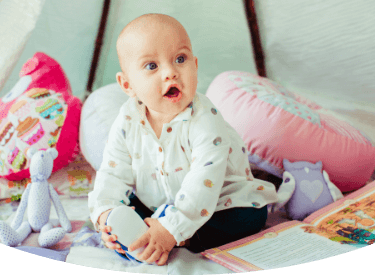
In the previous month, your baby`s growth rate had doubled with the effect of its transition to supplementary food. In the 7th month, its growth will slow down a bit. Your baby gains 450 grams of weight this month and grows less than 1 cm in length. This is part of its normal development, “My baby isn`t gaining weight!” Don`t think so.

Your baby will have learned to crawl by now, so be sure to keep choking hazards off the floor. Turning is also common, and your baby may also choose to roll anywhere. This chosen movement method varies greatly in kids, so it should not be too focused. Because some babies can go to the walking stage without crawling at all.

Its appetite will increase as it needs more energy than ever to power its rapid movements and brain development. Learning new skills also takes lots of energy.

Milestones

Although the baby has passed several milestones by this time, it is perfectly normal for progress to be slow. As mentioned earlier, these milestones are not rules, they are guidelines to help parents get an idea of how growing is progressing.

  1. It can search for a falling object.
  1. In the prone position, it can bring itself to a sitting position and sit unaided.
  1. Can pass objects in hand from one hand to the other.
  1. Can object when it receives its toy.
  1. Can put weight on the legs when held upright.
  1. Can clap and wave hands.
  1. Can put its feet in its mouth while lying on its back, it likes to look at its feet.
  1. Can distinguish strangers from loved ones.
  1. In the crawling position, it can support itself and extend one hand forward.
  1. Can use its thumb and other fingers better than in previous months.
  1. Can hold a spoon, even if it is not very successful.
  1. Can hit the objects in its hands against each other.
  1. Can listen to the sounds of others and itself.

Nutrition

During these weeks, you should start giving your baby more lumpy and varied supplementary foods. In this way, your baby`s chewing and swallowing skills develop better. If it is going to taste the foods you will give this month for the first time, you can give it in puree form. For all detailed lists, nutrients, recipes and nutrition tips, you can regularly follow our Monthly Baby Nutrition guide.

If there is a highchair, your baby can sit at the table with you at 7 months. In this way, it also observes your eating. You can also help it learn to eat its own meal by giving it a small snack or two while sitting in the highchair. This method is called BLW: Baby Led Weaning.

Some babies still may not be very inclined to solid foods. It is important to remember that the regular inclusion of solid food in a baby`s diet will most likely only occur until the age of one. You should never force solid foods on a baby. Enjoy family mealtimes and encourage solid food times by offering colorful and shaped food and plates, spoons or finger foods and allowing it to feed itself.

With the transition to supplementary food, the period of drinking water for your baby has started. The pH values and sodium ratios of water are very important for babies. Since their kidneys are still in the development stage, you should prefer those with low sodium content as much as possible.

Sleep

Sleep can sometimes be uncomfortable for a 28-week-old baby. You may find your baby waking up at odd hours of the night and crying. This occurs as a result of muscle exercise, the phenomenon in which the baby`s muscles become stronger while it sleeps. So it`s a growing pain.

Co-sleeping is preferred by parents as they can better meet the needs of their baby. You must ensure that safe bed-sharing rules are met with your baby so that both parents and baby do not experience difficulties.

If your baby still wakes up frequently at night, you can give it the opportunity to sleep on its own by sleep training. We recommend that you stop breastfeeding, bottle feeding, rocking or whatever you do for sleep training for a 7-month-old baby. However, you can apply methods such as breastfeeding and very light shaking before the baby goes to sleep. In this way, it becomes much easier to fall asleep, and you can have a peaceful sleep. A warm bath and baby massage will also be helpful.

Care Tips

  1. In this period, teething toys, cold cloth kept in the refrigerator will comfort the baby.
  1. Do not force your baby to eat solid foods, as this can have bad connotations in the long run.
  1. Going through the teething process, stuffy nose, wanting your attention or the wrong breastfeeding position can cause your baby to bite while feeding. You don`t feel this pain when it doesn’t have teeth, but the teeth are coming and you may be thinking what I can do. First of all, you should try to determine the cause of the bite. You should then try to eliminate that cause. The mother`s reaction when the baby bites the breast is also very important. Responding too aggressively and harshly may cause your baby to bite harder or move further away from the breast, while your smile may make it think you are playing and keep biting. So what can we do? As soon as it bites, take your breast out of its mouth with a firm `no` without reacting too harshly, and offer to breastfeed again after a while. If it bites again, repeat the same application. Thus, when your baby bites, it may realize that it cannot suckle and stop biting.
  1. At the seventh month, it`s time to replace the car seat. Now your little one is growing up and will need a new suitable car seat.
  1. It may be one of the best things you can do to leave it alone and not interfere with its movements.
  1. If your baby takes a different crawling position than it should be, don`t force it to crawl like you know. Don`t push it from behind or pick it up because it thinks it`s tired. This delays both walking and development.
  1. Your baby can sit up and roll over on the floor this month. That`s why it will do these movements often. Do not support it while doing these so that it can develop on its own. Of course, don`t leave the room you are in, watch its progress quietly in a corner.
  1. You can meet the fear of strangers, as the baby can distinguish between people and others it knows in these weeks. You can talk to your baby about this situation and get it used to it. "Look, this is your aunt." If it sees that you approve with sentences like this, its acceptance will be quicker. When stranger anxiety starts, respect its fear and don`t let it be loved by tactile contact. If it adopts the relevant person, it will already make its own choices.
  1. If you have a bathtub at home, great! You can fill the tub as much as your baby can sit and enjoy it. By controlling the temperature of the water with the thermometer or elbow method, as in the previous months, you can start your hours of playing and bathing in the tub. Of course, we don`t recommend turning your back even for a moment while you bathe it in the big tub. When bath time comes, you should have towels, bathrobes, shampoo, washcloths and all the clothes it will wear after the bath. You can get balls, ducks and other floating bath toys to make the bath more enjoyable. If you don`t have a tub at home, you can switch to a larger tub for your baby or quickly start washing in the shower area. But if you are going to wash in the shower cabin, you have to be very quick so that your baby does not get cold and sick. The bath temperature should be 25-26 degrees, and the water temperature should be 36-38 degrees.
  1. You should turn off electrical outlets, tidy up cables, put guards on pointed and sharp-edged furniture, and remove fragile items from its reach or completely.

Discipline Tips for Babies

For the first 6 months, you were able to prevent your baby from doing things you don`t want by distracting its attention, but your baby is growing now and if you don`t act early, your little one will do its best not to follow the rules.

The main purpose of the discipline is; While reinforcing the right behaviors and eliminating the wrong behaviors, it is to teach the baby self-discipline (internal discipline) over time. The baby is not born knowing the limits, it learns by experiencing the right and wrong behaviors, and tries what it is not allowed to do in this process, and continues to try until its parents direct it. In the fourth and fifth months, the baby biting the breast while sucking and the mother`s not allowing this behavior is an example of trying to discover its limits. The baby, who is not disciplined and without boundaries, is lost, cannot predict right and wrong behavior, does not know why to protect itself and what to experience safely.

The most important rule of discipline; is to be determined. If there is no determination, the baby understands the indecision of the parents and constantly tests them. If a rule applied one day is broken the next day, or if the parents apply different rules, or if one does not follow the rule applied by the other, the baby becomes confused and cannot internalize the rule correctly. The message the baby received from this indecision; that the rules can be changed according to the situation, and that it does not have to follow the rule. Of course, the baby will not understand the rules and boundaries at the first warning, which is why it is important to be determined. The baby getting the same reaction every time will eventually learn what not to do. While doing all these, be extremely compassionate, soft and calm. Your compassion and determination will enable you to raise a one complying with all your reasonable rules.

Interfering with everything the baby does and setting too many rules negatively affect even the most adaptable baby. That`s why it`s important to set rules and give the right instructions at the right time only on matters that are considered important. While setting the rules, the baby`s characteristics, development level, maturity level, need to explore, temperament, what it can and cannot achieve should be taken into consideration.

You have to make sure that the rules you set are really meaningful, that they are the right moves for its safety and development. Those outside this scope is subject to restriction of freedom and vice versa. Remember, babies who are blocked and get anger from their parents always tend to be maladaptive, angry and stubborn!

Tests and Vaccines

If previous vaccinations and tests have been completed, there is no special routine for this week.

Plays and Activities

Even if it has some time to walk, your baby`s leg muscles will have been strong enough to support its weight by now. If it starts bouncing on your lap, support it with your hands under its arms so that its legs develop faster.

Since grabbing and throwing is now the norm, let it throw its toys as many times as it wants. Do not take the thrown toys back as much as possible, leave that job to your baby. Floor games help the baby get up and walk much earlier.

You can teach the sounds of animals by buying colorful books. As you make the sounds, your imitator will accompany you. You can teach a game of tugging at an object such as a tiny blanket or towel, by both holding it and making it to hold it. You can hide the sound of one of its sound toys and have it find it.

Wooden cubes placed on top of each other, puzzles with large pieces, wooden hammer blocks, simplified musical instruments, teether with sounds, colors and toys are the ideal toys of this period.

When to Apply to The Doctor?

It is common for your baby to have a fever or rash at the vaccination region after vaccinations. However, if these symptoms persist for a while, it is best to pay a visit to the doctor. If the baby is younger than 6 months, especially 3 months, and has a fever of around 38 degrees, you should go to the hospital without delay. However, starting from this month, if the general condition is good and active, if there are no additional symptoms such as vomiting, cough, and diarrhea, it is recommended to monitor babies with fever around 38 degrees at home for 72 hours before going to the hospital.

28-Week-Old Baby: Development Week by Week

"Parenting instincts" are more than a cliché. It is a powerful tool that can help you grow your baby. You know your baby best so you can be an astute judge when it comes to changes in your baby`s condition.

Baby Development

In the previous month, your baby`s growth rate had doubled with the effect of its transition to supplementary food. In the 7th month, its growth will slow down a bit. Your baby gains 450 grams of weight this month and grows less than 1 cm in length. This is part of its normal development, “My baby isn`t gaining weight!” Don`t think so.

Your baby will have learned to crawl by now, so be sure to keep choking hazards off the floor. Turning is also common, and your baby may also choose to roll anywhere. This chosen movement method varies greatly in kids, so it should not be too focused. Because some babies can go to the walking stage without crawling at all.

Its appetite will increase as it needs more energy than ever to power its rapid movements and brain development. Learning new skills also takes lots of energy.

Milestones

Although the baby has passed several milestones by this time, it is perfectly normal for progress to be slow. As mentioned earlier, these milestones are not rules, they are guidelines to help parents get an idea of how growing is progressing.

  1. It can search for a falling object.
  1. In the prone position, it can bring itself to a sitting position and sit unaided.
  1. Can pass objects in hand from one hand to the other.
  1. Can object when it receives its toy.
  1. Can put weight on the legs when held upright.
  1. Can clap and wave hands.
  1. Can put its feet in its mouth while lying on its back, it likes to look at its feet.
  1. Can distinguish strangers from loved ones.
  1. In the crawling position, it can support itself and extend one hand forward.
  1. Can use its thumb and other fingers better than in previous months.
  1. Can hold a spoon, even if it is not very successful.
  1. Can hit the objects in its hands against each other.
  1. Can listen to the sounds of others and itself.

Nutrition

During these weeks, you should start giving your baby more lumpy and varied supplementary foods. In this way, your baby`s chewing and swallowing skills develop better. If it is going to taste the foods you will give this month for the first time, you can give it in puree form. For all detailed lists, nutrients, recipes and nutrition tips, you can regularly follow our Monthly Baby Nutrition guide.

If there is a highchair, your baby can sit at the table with you at 7 months. In this way, it also observes your eating. You can also help it learn to eat its own meal by giving it a small snack or two while sitting in the highchair. This method is called BLW: Baby Led Weaning.

Some babies still may not be very inclined to solid foods. It is important to remember that the regular inclusion of solid food in a baby`s diet will most likely only occur until the age of one. You should never force solid foods on a baby. Enjoy family mealtimes and encourage solid food times by offering colorful and shaped food and plates, spoons or finger foods and allowing it to feed itself.

With the transition to supplementary food, the period of drinking water for your baby has started. The pH values and sodium ratios of water are very important for babies. Since their kidneys are still in the development stage, you should prefer those with low sodium content as much as possible.

Sleep

Sleep can sometimes be uncomfortable for a 28-week-old baby. You may find your baby waking up at odd hours of the night and crying. This occurs as a result of muscle exercise, the phenomenon in which the baby`s muscles become stronger while it sleeps. So it`s a growing pain.

Co-sleeping is preferred by parents as they can better meet the needs of their baby. You must ensure that safe bed-sharing rules are met with your baby so that both parents and baby do not experience difficulties.

If your baby still wakes up frequently at night, you can give it the opportunity to sleep on its own by sleep training. We recommend that you stop breastfeeding, bottle feeding, rocking or whatever you do for sleep training for a 7-month-old baby. However, you can apply methods such as breastfeeding and very light shaking before the baby goes to sleep. In this way, it becomes much easier to fall asleep, and you can have a peaceful sleep. A warm bath and baby massage will also be helpful.

Care Tips

  1. In this period, teething toys, cold cloth kept in the refrigerator will comfort the baby.
  1. Do not force your baby to eat solid foods, as this can have bad connotations in the long run.
  1. Going through the teething process, stuffy nose, wanting your attention or the wrong breastfeeding position can cause your baby to bite while feeding. You don`t feel this pain when it doesn’t have teeth, but the teeth are coming and you may be thinking what I can do. First of all, you should try to determine the cause of the bite. You should then try to eliminate that cause. The mother`s reaction when the baby bites the breast is also very important. Responding too aggressively and harshly may cause your baby to bite harder or move further away from the breast, while your smile may make it think you are playing and keep biting. So what can we do? As soon as it bites, take your breast out of its mouth with a firm `no` without reacting too harshly, and offer to breastfeed again after a while. If it bites again, repeat the same application. Thus, when your baby bites, it may realize that it cannot suckle and stop biting.
  1. At the seventh month, it`s time to replace the car seat. Now your little one is growing up and will need a new suitable car seat.
  1. It may be one of the best things you can do to leave it alone and not interfere with its movements.
  1. If your baby takes a different crawling position than it should be, don`t force it to crawl like you know. Don`t push it from behind or pick it up because it thinks it`s tired. This delays both walking and development.
  1. Your baby can sit up and roll over on the floor this month. That`s why it will do these movements often. Do not support it while doing these so that it can develop on its own. Of course, don`t leave the room you are in, watch its progress quietly in a corner.
  1. You can meet the fear of strangers, as the baby can distinguish between people and others it knows in these weeks. You can talk to your baby about this situation and get it used to it. "Look, this is your aunt." If it sees that you approve with sentences like this, its acceptance will be quicker. When stranger anxiety starts, respect its fear and don`t let it be loved by tactile contact. If it adopts the relevant person, it will already make its own choices.
  1. If you have a bathtub at home, great! You can fill the tub as much as your baby can sit and enjoy it. By controlling the temperature of the water with the thermometer or elbow method, as in the previous months, you can start your hours of playing and bathing in the tub. Of course, we don`t recommend turning your back even for a moment while you bathe it in the big tub. When bath time comes, you should have towels, bathrobes, shampoo, washcloths and all the clothes it will wear after the bath. You can get balls, ducks and other floating bath toys to make the bath more enjoyable. If you don`t have a tub at home, you can switch to a larger tub for your baby or quickly start washing in the shower area. But if you are going to wash in the shower cabin, you have to be very quick so that your baby does not get cold and sick. The bath temperature should be 25-26 degrees, and the water temperature should be 36-38 degrees.
  1. You should turn off electrical outlets, tidy up cables, put guards on pointed and sharp-edged furniture, and remove fragile items from its reach or completely.

Discipline Tips for Babies

For the first 6 months, you were able to prevent your baby from doing things you don`t want by distracting its attention, but your baby is growing now and if you don`t act early, your little one will do its best not to follow the rules.

The main purpose of the discipline is; While reinforcing the right behaviors and eliminating the wrong behaviors, it is to teach the baby self-discipline (internal discipline) over time. The baby is not born knowing the limits, it learns by experiencing the right and wrong behaviors, and tries what it is not allowed to do in this process, and continues to try until its parents direct it. In the fourth and fifth months, the baby biting the breast while sucking and the mother`s not allowing this behavior is an example of trying to discover its limits. The baby, who is not disciplined and without boundaries, is lost, cannot predict right and wrong behavior, does not know why to protect itself and what to experience safely.

The most important rule of discipline; is to be determined. If there is no determination, the baby understands the indecision of the parents and constantly tests them. If a rule applied one day is broken the next day, or if the parents apply different rules, or if one does not follow the rule applied by the other, the baby becomes confused and cannot internalize the rule correctly. The message the baby received from this indecision; that the rules can be changed according to the situation, and that it does not have to follow the rule. Of course, the baby will not understand the rules and boundaries at the first warning, which is why it is important to be determined. The baby getting the same reaction every time will eventually learn what not to do. While doing all these, be extremely compassionate, soft and calm. Your compassion and determination will enable you to raise a one complying with all your reasonable rules.

Interfering with everything the baby does and setting too many rules negatively affect even the most adaptable baby. That`s why it`s important to set rules and give the right instructions at the right time only on matters that are considered important. While setting the rules, the baby`s characteristics, development level, maturity level, need to explore, temperament, what it can and cannot achieve should be taken into consideration.

You have to make sure that the rules you set are really meaningful, that they are the right moves for its safety and development. Those outside this scope is subject to restriction of freedom and vice versa. Remember, babies who are blocked and get anger from their parents always tend to be maladaptive, angry and stubborn!

Tests and Vaccines

If previous vaccinations and tests have been completed, there is no special routine for this week.

Plays and Activities

Even if it has some time to walk, your baby`s leg muscles will have been strong enough to support its weight by now. If it starts bouncing on your lap, support it with your hands under its arms so that its legs develop faster.

Since grabbing and throwing is now the norm, let it throw its toys as many times as it wants. Do not take the thrown toys back as much as possible, leave that job to your baby. Floor games help the baby get up and walk much earlier.

You can teach the sounds of animals by buying colorful books. As you make the sounds, your imitator will accompany you. You can teach a game of tugging at an object such as a tiny blanket or towel, by both holding it and making it to hold it. You can hide the sound of one of its sound toys and have it find it.

Wooden cubes placed on top of each other, puzzles with large pieces, wooden hammer blocks, simplified musical instruments, teether with sounds, colors and toys are the ideal toys of this period.

When to Apply to The Doctor?

It is common for your baby to have a fever or rash at the vaccination region after vaccinations. However, if these symptoms persist for a while, it is best to pay a visit to the doctor. If the baby is younger than 6 months, especially 3 months, and has a fever of around 38 degrees, you should go to the hospital without delay. However, starting from this month, if the general condition is good and active, if there are no additional symptoms such as vomiting, cough, and diarrhea, it is recommended to monitor babies with fever around 38 degrees at home for 72 hours before going to the hospital.