


Your baby`s bond with you has never been stronger. If your baby is afraid of everyone but you, soothe that discomfort by guiding your baby`s interactions with others.
Baby Development

Your baby`s cognitive, social, emotional and physical development is in full swing, such as fear of being alone in a room and separation anxiety, discovering and being surprised by the nuances of cause and effect. While it may seem a little chubby these months, those knuckles will disappear as soon as it specializes in worrying, crawling, and walking.
Separation anxiety is at its peak now and for the next few months. It`s okay if your baby uses fingers or a pacifier to soothe itself while dealing with its anxiety. Sucking is one of your baby`s ways to calm itself down.
Milestones
- First words: Pay attention to its facial expressions and gestures when saying its first words. It may be vague at first, but it`s definitely picking up.
- Standing with support: Your baby will soon try to stand by holding onto that coffee table in the living room of your home. It can also try to walk with support on its own, or at least take a few steps.
- Crawling and sitting: You will notice that your little one is quickly moving from one room to the next or moving around furniture easily. It should be able to sit comfortably on its own. It can go from a prone position to a sitting position.
- It may try to catch a distant toy.
- Can play hand games, clap its hands.
- Can try various ways for the things it wants to achieve. For example, if a distant toy has a pillow in front of it, it may push it away. It can follow falling objects.
- Can drink water from a cup or glass alone. We also recommend using a training glass for its first try.
- Can play ball. If you throw it to it, it can throw it back to you.
- Can understand words such as no and yes. Even if it doesn`t always apply!
- Can imitate the sounds it hears.
- Can distinguish and react to strangers.
Nutrition
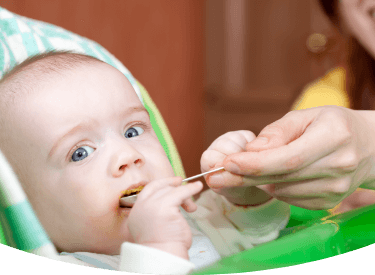
It can be frustrating to realize that your baby is no longer enjoying the foods it ate before this stage. This is because some innovations have become routine for it. Try to offer more variety. Make sure you provide plenty of options for it to explore tastes and textures. Let it decide what it wants to eat and how often. You may notice fluctuations in its appetite, and that`s because it`s too busy exploring and getting around. Eating becomes a second priority, but still a priority. Don`t force your little one to eat what it doesn`t want and let it explore its appetite as this encourages healthy eating habits.
Your baby should definitely accompany you at the table. Even if you have already given its meal, you can sit next to it with the table chair and let it try fresh foods. With each passing day, you can practice with a more lumpy food than the previous one. Whenever you bring the spoon close, it attacks your hand and wants to eat on its own, it`s time to use a spoon. Your baby is now growing and independence is calling for it. Don`t discourage it.
When you have difficulty in feeding it, you should put as little food on the plate as possible. The baby should eat because it is hungry, not because you want it. If it absolutely does not want more or does not eat at all, take the plate in front of it and finish that meal. After that, do not give foods such as crackers and biscuits that will lose its appetite with the thought of being hungry. If you do not give these foods, your baby will eat the next meal with more appetite. In no case do not show digital screens for it to eat.
Whether it is breastfeeding or formula-fed, it remains the most important nutrient until its first birthday. Do not start giving cow`s milk until 1-year-old, as its digestive system is not ready.
Sleep
Your baby`s daytime naps can now be divided into two parts. Even a little, some babies may tend to sleep alone during this period. If it refuses to sleep during the day and becomes grumpy and unhappy during the day, it means it still needs that sleep. If you are one of the parents who prefer to sleep together, make sure you provide safe bed sharing. Many parents say its babies with sleep problems sleep longer after they start co-sleeping. This remains entirely your choice. If you wish, you can provide sleep training and make it sleep on its own, if you wish, you can breastfeed every time it wakes up or sleep together. Babies at this age also like to listen to white noise or sleep music before going to bed (or bedtime). It has been observed that babies who spend quality time with their parents in a quiet environment, in a dim light, for half an hour before sleep, sleep well, unless they have physical pain.
The ideal sleep pattern and hours from the 9th to the 12th month are as follows: Number of daytime naps 2, Daytime naps duration 1-2 hours, Time to stay awake between day naps 3 hours, Nighttime sleep time 19.00-20.00, Night sleep duration 10-12 hours, Total daily sleep time 12-14 hours.
Care Tips
- Distract it while breastfeeding: Nine-month-olds are curious and love to explore, but that shouldn`t stop them from breastfeeding. It may turn its head to observe its surroundings while breastfeeding, so be sure to engage it by talking to it. Feed it as a first thing in the morning or just before it goes to sleep at night. Turn off the lights while breastfeeding to avoid being distracted and fidgety.
- Offer snacks: Your baby will now have frequent gripping exercises; you can offer finger foods or snacks to liven it up. Give it carrot sticks and simple foods that it can pick up with its thumb and forefinger. Make sure they don`t stick in its throat and are edible. Add variety to allow it to explore different flavors/textures and discover what it likes and dislikes.
- Let your baby explore as it grows and the best thing to do as a parent is to remain flexible and adaptable to new perspectives. Remember, the blocked baby will be grumpy and maladaptive.
- Traveling with your baby right now can be difficult. It`s used to its surroundings and familiar faces and loves predictability. So being on the road can disrupt the sense of security and routine, especially when visiting a new place or meeting lots of strangers. At this age, it doesn`t understand the concept of travel, but it will realize that it is in a stranger place. Be prepared for some grumpy, clingy behavior and pack plenty of distractors - picture books, noisy toys, etc.
- Pack yourself nutritious, easy-to-carry snacks while you organize the diaper bag for a trip.
- It`s important to stay hydrated, especially if you`re breastfeeding. If your urine is clear or light yellow, it`s a good sign that you`re drinking enough. But be careful what you drink. Experts say that breastfeeding mothers should limit their caffeine consumption (such as coffee, tea, soft drinks, energy drinks, and cocoa) to no more than 300 milligrams per day. More than that can cause your baby to be restless and have trouble in sleeping.
Tests and Vaccines
Your baby will not need any vaccines at this age. The 9-month-old baby will be checked for iron deficiency under the doctor`s control. In the 9th month, it is recommended to have blood and urine analysis for general evaluation. Its doctor may ask your little one to crawl on the floor or have a pincer grasp to assess how it moves, holds, plays, and more. Until the testing phase, you will be asked questions about your baby`s eating and sleeping patterns, so be sure to write down all of this before taking it to a pediatrician.
Plays and Activities
- Fruit faces: Cut pieces of fruit such as kiwi, apple, watermelon and banana and show your little one how to make faces with them. Make funny fruit faces and encourage it to imitate you. When you`re done, eat and enjoy!
- Spending time in nature: This is a good age to instill attention and develop observational skills. Take your baby to a park or garden and lie down on the grass. Close your eyes and ask your baby to do the same. Then ask it to describe what sounds it heard. When bored, open both eyes and enjoy looking at the clouds. Ask it also to describe the shapes and patterns in the sky.
When to Apply to The Doctor?
Consult a doctor if it does not move much, cannot sit up properly without support or on its own, does not eat anything, or has a persistently low appetite.