

Get our app

Download on the App Store

52-Week-Old Baby: Development Week by Week

It`s hard to believe that a full year has passed since it was born. Every baby is a unique person. They travel at their own pace on their journey. Now is the time to celebrate not only your baby`s birthday, but all the time you`ve shared with it!

Baby Development

Your baby`s birth weight can triple by the end of the first year. Between 12 and 14 months of age, babies begin to dream actively in their sleep. These dreams can sometimes startle and wake your baby. At such moments, you should comfort it until it falls asleep again.

Its language skills will improve quickly and it will soon be able to communicate with people who do not understand its gestures. Physically, if it is currently a wobbly walker, it will soon be capable of running, jumping and dancing. Its self-concept will also be strengthened, making it easier for it to interact with strangers and other kids. The only thing that remains unchanged is that it will always ask for your love and support.

During this period, you may observe that your baby is overly dependent on one or more items. These items are; It can be blankets, teddy bears, clothes, and it may want to take it wherever it goes. This may be because it has seen too many stranger faces. If this situation bothers you a lot, you can buy your baby an alternative to the item that it loves and is overly attached to, and you can make it like it also. If you don`t want it to be something that it is too attached to, you should try to gradually forget the thing it is attached to.

Milestones

  1. Your baby can use symbols for words using hand gestures.
  1. It will be able to return to your high five.
  1. Will take its first steps at this age.
  1. Will have developed fine motor skills such as picking grapes between its thumb and forefinger.
  1. Will know that objects and things will exist even if it can`t see them.
  1. Will be able to understand about 25 words and respond to simple one-step instructions.
  1. Can recognize favorite things and places.
  1. Can point at something and ask you a question, even if it doesn`t use words to ask.
  1. Can climb up and down the bed or on the sofa.
  1. Loves to rummage through drawers or baskets and take their contents out. Now its hands are reaching everywhere.
  1. Pulls the covers.
  1. Can drink from a glass by itself or with assistance.
  1. Can speak a strange language that it finds itself.
  1. Can understand and obey verbal orders without signs.
  1. Plays ball, rolls the ball back to you if you roll it to it.
  1. Despite walking, it may continue to crawl in order to move quickly.
  1. Knows the words “mother” and “father”. "Where is Mother?" It turns and looks at you.
  1. May cry when separated from you.
  1. Does not go to strangers` laps, cries.

Nutrition
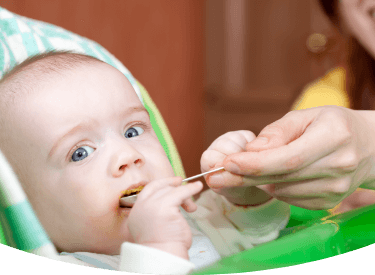
Your toddler should now eat a wide variety of foods and breast milk should be the secondary diet. You can begin to lessen its reliance on a bottle or breast feeding by gradually replacing with its night feed with milk or water in the cup. Your baby may be picky about food, continue to offer a variety of healthy meals. Do not force it to eat more than its appetite can take, and keep snacks and junk food out of its diet... Many banned options as cow`s milk and honey are included in the nutrition list with 1-year-old.

Do not skip feeding routines and meals, babies get cranky when their routine is disrupted. Choose foods that are low in calories and high in nutrients. As the level of movement increases, it can lose weight, don`t worry if it eats healthy foods. It is also possible that it rejects the foods it loves very much and turns to other foods. You continue to offer a wide variety. Let it eat by itself using a fork and spoon.

It is recommended to continue breastfeeding until 2 years of age. The baby taking breast milk 3-5 times a day does not need additional milk. 1-2 tablespoons of yogurt are enough.

A morning breakfast with eggs and breakfast items; snack consisting of fresh seasonal fruits; A meal with meat, fish or chicken, along with yoghurt and pasta can be an ideal choice for lunch and dinner.

Three main meals and two snacks are suitable for feeding a 1-year-old baby. Its program; You can set it as breakfast, snack, lunch, snack and dinner. So how much should it eat? There is a very simple rule of feeding a 12-month-old baby: Your little one should be fed as much as its age. What does this mean? So, if your baby is 1-year-old, it should eat at least one tablespoon of each meal in its meal. For example; If it is going to eat chicken rice, spinach and yogurt, it is enough to take one tablespoon of each. Your baby shows how much it can eat with its reactions, it is important that you observe and listen to this.

Sleep

One of the biggest interruptions in a baby`s sleep in the second six months is the development of crawling. Research shows that sleep interruption is typical for a month before crawling and up to three months after. This also applies to the walking phase. In the second half of the first year, the baby will become more sensitive to noise and tension in the family, and this can cause interrupted sleep. It may wake up from its sleep and cry because of scary dreams or separation anxiety. If you calm your baby waking up crying at night and put it back to sleep, its sleep will be restored within 7-10 days.

During the first year of your baby`s life, there will be a total of 23 weeks of `grumpy periods` in its sleep! This is because of mental and physical development, growth spurts, and the progress of mobility your baby is experiencing. We`re not even talking about teething. On average, 12-month-old babies should have between 1 and 8 milk teeth. Eight more teeth will arrive by its 2nd birthday. After 1 year, most of the sleep problems usually disappear.

Although most babies need 2 separate naps during this period, it is seen that daytime sleepiness is reduced to 1 in some babies. In fact, the baby may stop sleeping first in the morning. If your baby has gone to sleep alone, you can prevent it from feeling tired and exhausted by taking its lunch and night sleep a little forward. With 1-year-old baby`s sleep, most of the little ones do not need to be fed at night. Baby needs breast or bottle sucking just to relax.

Care Tips

  1. Avoid giving your baby processed fruit juices because they have high sugar content that can fill it up and thus it doesn’t want to eat, moreover, they are also unhealthy.
  1. Add protein to your baby`s diet from a variety of sources such as peas, cheese, eggs, beans and yogurt.
  1. If your baby refuses to feed itself, don`t force it to feed. You can make little games for it to get used to eating its own food. In addition, giving finger food at meals is the pioneer of self-feeding. You can provide it confidence in its work by encouraging and praising it when it eats by itself.
  1. Be sure to respond with joy and interest when your baby points to something and looks at you expectantly.
  1. Keep pointing and naming objects.
  1. Keep telling your baby stories from picture books.
  1. Establish a bedtime routine that works for you including bathing, drinking a glass of milk, brushing teeth, and a bedtime story.
  1. Now it`s time to buy soft shoes for your baby!
  1. Do not interfere while eating, playing games or doing any activity that it is concentrating on, unless there is a dangerous situation.
  1. Use your “no”s only for dangerous situations. Choose to give positive guidance for a situation that should not be done; It`s not "no, don`t do it", it`s like "that`s not right" or "let`s see what we have here". Also, make sure that the situations you don`t allow are really reasonable, don`t choose to be a forbidding, oppressive parent, babies raised free and allowed to explore develop harmonious and confident personalities, not rebels. It is not the personality of your dreams, it will realize its own personality, remember that you are not the owner, but you are the guide. The important thing is to provide your guidance in the most accurate and safe ways.

Tests and Vaccines

When your baby is 1-year-old, it is recommended to have a doctor`s control.

  1. Tests: The doctor will measure your baby`s height, weight, and head circumference to assess its growth. It will also ask you a series of questions about your baby so that it can assess your baby`s sleeping habits, vision, physical and behavioral development. It may also order a blood test and urinalysis to check your baby`s blood values. It will also check to see if it is talking, pointing, walking. The doctor may ask how many words your baby can speak, so count these and keep them in mind.
  1. Vaccines: Yes, it`s time for vaccinations. MMR vaccine including Measles, Rubella, Mumps vaccines, Pneumococcal vaccine and Chickenpox vaccine will be given at the age of 1.

Plays and Activities

  1. Print your baby`s hand or foot in some poster ink and print on a sheet of white paper. You can then frame this print or save it for the next generation.
  1. Playing hide-and-seek games with your mobile baby in every room of the house will make it very happy.
  1. You can carry your usual games to bath time. Water is very attractive for babies during this period. Even throwing water from one container to another is enough for it. You can make bathrooms’ fun with bathtub paints that can be cleaned with water.

When to Apply to The Doctor?

Consult your doctor if you notice the following in your 52-week-old baby`s development:

  1. Does your baby have an allergic reaction to strawberries, honey, cow`s milk, eggs, nuts or other foods? Symptoms can range from rashes to watery eyes, a swollen tongue, face or hands, and even difficulty in breathing. Consult your doctor if you observe something like this in your baby.
  1. If your baby is losing weight but shows signs of fever or diarrhea and refuses to eat, take it to a doctor as it may have an infection.
  1. It is always better to consult a doctor once before adding cow`s milk to your baby`s diet.

52-Week-Old Baby: Development Week by Week

It`s hard to believe that a full year has passed since it was born. Every baby is a unique person. They travel at their own pace on their journey. Now is the time to celebrate not only your baby`s birthday, but all the time you`ve shared with it!

Baby Development

Your baby`s birth weight can triple by the end of the first year. Between 12 and 14 months of age, babies begin to dream actively in their sleep. These dreams can sometimes startle and wake your baby. At such moments, you should comfort it until it falls asleep again.

Its language skills will improve quickly and it will soon be able to communicate with people who do not understand its gestures. Physically, if it is currently a wobbly walker, it will soon be capable of running, jumping and dancing. Its self-concept will also be strengthened, making it easier for it to interact with strangers and other kids. The only thing that remains unchanged is that it will always ask for your love and support.

During this period, you may observe that your baby is overly dependent on one or more items. These items are; It can be blankets, teddy bears, clothes, and it may want to take it wherever it goes. This may be because it has seen too many stranger faces. If this situation bothers you a lot, you can buy your baby an alternative to the item that it loves and is overly attached to, and you can make it like it also. If you don`t want it to be something that it is too attached to, you should try to gradually forget the thing it is attached to.

Milestones

  1. Your baby can use symbols for words using hand gestures.
  1. It will be able to return to your high five.
  1. Will take its first steps at this age.
  1. Will have developed fine motor skills such as picking grapes between its thumb and forefinger.
  1. Will know that objects and things will exist even if it can`t see them.
  1. Will be able to understand about 25 words and respond to simple one-step instructions.
  1. Can recognize favorite things and places.
  1. Can point at something and ask you a question, even if it doesn`t use words to ask.
  1. Can climb up and down the bed or on the sofa.
  1. Loves to rummage through drawers or baskets and take their contents out. Now its hands are reaching everywhere.
  1. Pulls the covers.
  1. Can drink from a glass by itself or with assistance.
  1. Can speak a strange language that it finds itself.
  1. Can understand and obey verbal orders without signs.
  1. Plays ball, rolls the ball back to you if you roll it to it.
  1. Despite walking, it may continue to crawl in order to move quickly.
  1. Knows the words “mother” and “father”. "Where is Mother?" It turns and looks at you.
  1. May cry when separated from you.
  1. Does not go to strangers` laps, cries.

Nutrition

Your toddler should now eat a wide variety of foods and breast milk should be the secondary diet. You can begin to lessen its reliance on a bottle or breast feeding by gradually replacing with its night feed with milk or water in the cup. Your baby may be picky about food, continue to offer a variety of healthy meals. Do not force it to eat more than its appetite can take, and keep snacks and junk food out of its diet... Many banned options as cow`s milk and honey are included in the nutrition list with 1-year-old.

Do not skip feeding routines and meals, babies get cranky when their routine is disrupted. Choose foods that are low in calories and high in nutrients. As the level of movement increases, it can lose weight, don`t worry if it eats healthy foods. It is also possible that it rejects the foods it loves very much and turns to other foods. You continue to offer a wide variety. Let it eat by itself using a fork and spoon.

It is recommended to continue breastfeeding until 2 years of age. The baby taking breast milk 3-5 times a day does not need additional milk. 1-2 tablespoons of yogurt are enough.

A morning breakfast with eggs and breakfast items; snack consisting of fresh seasonal fruits; A meal with meat, fish or chicken, along with yoghurt and pasta can be an ideal choice for lunch and dinner.

Three main meals and two snacks are suitable for feeding a 1-year-old baby. Its program; You can set it as breakfast, snack, lunch, snack and dinner. So how much should it eat? There is a very simple rule of feeding a 12-month-old baby: Your little one should be fed as much as its age. What does this mean? So, if your baby is 1-year-old, it should eat at least one tablespoon of each meal in its meal. For example; If it is going to eat chicken rice, spinach and yogurt, it is enough to take one tablespoon of each. Your baby shows how much it can eat with its reactions, it is important that you observe and listen to this.

Sleep

One of the biggest interruptions in a baby`s sleep in the second six months is the development of crawling. Research shows that sleep interruption is typical for a month before crawling and up to three months after. This also applies to the walking phase. In the second half of the first year, the baby will become more sensitive to noise and tension in the family, and this can cause interrupted sleep. It may wake up from its sleep and cry because of scary dreams or separation anxiety. If you calm your baby waking up crying at night and put it back to sleep, its sleep will be restored within 7-10 days.

During the first year of your baby`s life, there will be a total of 23 weeks of `grumpy periods` in its sleep! This is because of mental and physical development, growth spurts, and the progress of mobility your baby is experiencing. We`re not even talking about teething. On average, 12-month-old babies should have between 1 and 8 milk teeth. Eight more teeth will arrive by its 2nd birthday. After 1 year, most of the sleep problems usually disappear.

Although most babies need 2 separate naps during this period, it is seen that daytime sleepiness is reduced to 1 in some babies. In fact, the baby may stop sleeping first in the morning. If your baby has gone to sleep alone, you can prevent it from feeling tired and exhausted by taking its lunch and night sleep a little forward. With 1-year-old baby`s sleep, most of the little ones do not need to be fed at night. Baby needs breast or bottle sucking just to relax.

Care Tips

  1. Avoid giving your baby processed fruit juices because they have high sugar content that can fill it up and thus it doesn’t want to eat, moreover, they are also unhealthy.
  1. Add protein to your baby`s diet from a variety of sources such as peas, cheese, eggs, beans and yogurt.
  1. If your baby refuses to feed itself, don`t force it to feed. You can make little games for it to get used to eating its own food. In addition, giving finger food at meals is the pioneer of self-feeding. You can provide it confidence in its work by encouraging and praising it when it eats by itself.
  1. Be sure to respond with joy and interest when your baby points to something and looks at you expectantly.
  1. Keep pointing and naming objects.
  1. Keep telling your baby stories from picture books.
  1. Establish a bedtime routine that works for you including bathing, drinking a glass of milk, brushing teeth, and a bedtime story.
  1. Now it`s time to buy soft shoes for your baby!
  1. Do not interfere while eating, playing games or doing any activity that it is concentrating on, unless there is a dangerous situation.
  1. Use your “no”s only for dangerous situations. Choose to give positive guidance for a situation that should not be done; It`s not "no, don`t do it", it`s like "that`s not right" or "let`s see what we have here". Also, make sure that the situations you don`t allow are really reasonable, don`t choose to be a forbidding, oppressive parent, babies raised free and allowed to explore develop harmonious and confident personalities, not rebels. It is not the personality of your dreams, it will realize its own personality, remember that you are not the owner, but you are the guide. The important thing is to provide your guidance in the most accurate and safe ways.

Tests and Vaccines

When your baby is 1-year-old, it is recommended to have a doctor`s control.

  1. Tests: The doctor will measure your baby`s height, weight, and head circumference to assess its growth. It will also ask you a series of questions about your baby so that it can assess your baby`s sleeping habits, vision, physical and behavioral development. It may also order a blood test and urinalysis to check your baby`s blood values. It will also check to see if it is talking, pointing, walking. The doctor may ask how many words your baby can speak, so count these and keep them in mind.
  1. Vaccines: Yes, it`s time for vaccinations. MMR vaccine including Measles, Rubella, Mumps vaccines, Pneumococcal vaccine and Chickenpox vaccine will be given at the age of 1.

Plays and Activities

  1. Print your baby`s hand or foot in some poster ink and print on a sheet of white paper. You can then frame this print or save it for the next generation.
  1. Playing hide-and-seek games with your mobile baby in every room of the house will make it very happy.
  1. You can carry your usual games to bath time. Water is very attractive for babies during this period. Even throwing water from one container to another is enough for it. You can make bathrooms’ fun with bathtub paints that can be cleaned with water.

When to Apply to The Doctor?

Consult your doctor if you notice the following in your 52-week-old baby`s development:

  1. Does your baby have an allergic reaction to strawberries, honey, cow`s milk, eggs, nuts or other foods? Symptoms can range from rashes to watery eyes, a swollen tongue, face or hands, and even difficulty in breathing. Consult your doctor if you observe something like this in your baby.
  1. If your baby is losing weight but shows signs of fever or diarrhea and refuses to eat, take it to a doctor as it may have an infection.
  1. It is always better to consult a doctor once before adding cow`s milk to your baby`s diet.