


You have successfully stepped into week 30. Congratulations! This is the third trimester and you are constantly moving towards that much anticipated milestone. If you haven`t already, this would be the best time to pack your maternity bag. You may also be overloaded with the information you`ve learned, the do`s and don`ts, tips, and your doctor`s visits and pain. Try not to panic at this stage and offer yourself times of comfort.
Baby Growth
Your baby is rapidly gaining weight and as it grows, the amniotic fluid surrounding it is shrinking. Its eyesight is developing and your baby`s skeleton is also getting hardening.
First of all, as of the 30th week, you can check the movements of the fetus twice a day, once in the morning and once in the evening. Surely, your doctor will also give you some suggestions in this process. Additionally, you can try:
- Look at the clock and start counting. Count any action of kicking, turning, fluttering, rubbing. When you count 10 moves, stop and look at the clock. Note the elapsed time. Often, you can feel 10 movements in 10 minutes. It could be a little under or over 10 minutes.
- If you haven`t counted 10 moves after an hour, have a drink, snack, walk or do some light exercises. Then lie down again, relax and keep counting.
- A quiet day does not necessarily indicate that something is wrong, but on rare occasions it can be an alarm. The closer the date of birth, the more important it is to control fetal movements.
Baby Size
Your baby`s height is now about 39.9 cm from heel to head. The baby is roughly the size of a cabbage and weighs about 1319 grams. The baby will continue to grow rapidly and although it may increase slightly in height, the weight will increase considerably over the next few weeks until it is born.
Common Body Changes
By week 30, your belly has grown and you may want to be prepared for your birth options as the due date approaches. Body changes during pregnancy are quite rapid during the last trimester. At the end of 30 weeks, your weight gain will be somewhere between 8 and 13 kg. Do not worry about gaining weight in the last trimester as it is quite normal. Your body may feel heavier than usual and it may be difficult to do some regular chores. Still, there are only nine or ten weeks until your bundle of joy arrives in your arms, so enjoy this period. When measured at the 30th week of pregnancy, the uterus is 10 cm above the belly button. The measurement from the pubic symphysis to the apex of the uterus is 30 cm.
You will also need frequent toilet breaks as there is increased pressure on your bladder as your baby takes up most of the space in the womb. Your breasts will become tender as they prepare for milk production to breastfeed your baby.
Pregnancy Symptoms
- Heartburn will continue as the valve that prevents acid from entering the esophagus relaxes and acid begins to leak into the esophagus.
- Difficulty in breathing as the baby puts pressure on your diaphragm.
- Digestive problems due to relaxation of muscles.
- Bloating and gas problem caused by slow movement of the muscles.
- Constipation and hemorrhoids will continue depending on the relaxation of the muscles.
- As the center of gravity changes, you may have difficulty in balancing while walking.
- Leg cramps (or varicose veins) and back pain as the baby pushes back and the uterus puts pressure on the veins that carry blood to the legs.
- Itching in the navel area as the skin stretches to accommodate the baby.
- Discomfort while sleeping because your stomach is large.
- Frequent urination due to the baby pressing on the bladder.
- Fatigue caused by carrying excess weight and hormonal changes.
Abdomen
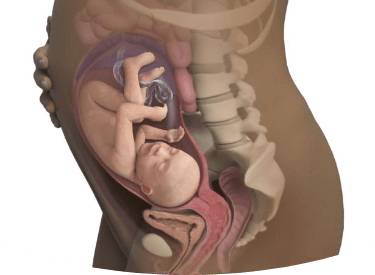
Your belly is now the size of a watermelon. It can be difficult to bend over and pick up things, even tying shoelaces. You may feel as if you cannot walk straight and steady, which is normal. Your shortness of breath will decrease as your baby enters the pelvis area in preparation for birth. Kicks and punches are now more pronounced as the baby completely occupies the uterus. You may experience false contractions, also called Braxton Hicks contractions. That`s why you should talk to your gynecologist and understand the difference between false contractions and true labor contractions.
Couples hesitate to have sex during this period, but it is harmless to have sexual intercourse unless otherwise stated by the doctor.
Ultrasound
Your baby is gaining weight rapidly and its lungs and digestive system are fully developed. The baby can now detect light and can also open and close its eyes. If you shine a light on your tummy, your baby will feel it and even reach out to touch it. The skin has softened and the brain tissues are developing rapidly. It can now grasp a finger using its hands.
Your baby`s bone marrow has started to produce red blood cells on its own so your baby can survive on its own after birth. Lanugo (the soft hair covering the baby`s body), body fat and the brain are starting to disappear as they now regulate the baby`s body temperature.
Diet
The diet at week 30 of pregnancy includes many iron-rich items such as:
- Lean meat and fish
- Broccoli and other green leafy vegetables
- Whole grains
- Lentils and pulses
- Nuts and dried fruits
- Eggs
Iron is essential throughout your pregnancy as it carries oxygen throughout your body through blood vessels and passes to the baby via the placenta. Avoid foods that inhibit iron absorption, instead eat plenty of foods that aid iron absorption, such as foods rich in vitamin C. Drinking a glass of fruit juice rich in vitamin C can be a good complement.
Calcium is also very important, but you should never take calcium and iron supplements together because calcium can interfere with the absorption of iron. Iron deficiency can hinder cognitive development in the fetus and may also cause anemia in the mother, which can cause pregnancy complications.
Tips and Care
Here are some simple tips to help you get through this week:
- Decide on stem cell storage as it may be useful for future medical use.
- Check baby movements.
- Do light exercises.
- Eat foods rich in iron.
- We know that your pregnancy gets harder as time goes on. So we invite you to think more or less about the delivery room already. Decide ahead of time how you want your room to be for today, which you will enjoy after giving birth and will remember with a beautiful smile.
- If you will need a caregiver after birth, you should start researching gradually.
Don’ts
- Do not ignore any contraction or watering.
- Do not do strenuous activities.
- If baby movements are less than normal, do not panic, visit your doctor.
- Avoid taking a bath with very hot water.
- Take careful steps in places with slippery floors such as bathrooms.
Shopping
Here are different things to keep ready:
- Cord banking (if you plan to store stem cells).
- Maternity clothes and nursing bras.
- Baby supplies (soap, towel, wrap, baby wipes).
Your baby is listening and is only ten weeks away from reaching your arms. Try to use this period to connect with it before it even comes into this world. Discomfort and hormonal changes can cause expectant mothers to become depressed during the third trimester of pregnancy. If you think you are in an extremely low mood and depressed about your pregnancy, talk to your doctor who can guide you through this period of anxiety. While the third trimester can be exhausting and painful, it brings you closer to the people around you and can also be the right time for baby shower celebrations and a romantic pre-baby photo shoot.